
Leading Authentically: Providing supervision that centres neurodivergent therapists and real practice growth


Supervision is more than a professional requirement. At its best, supervision is a relational, reflective and developmental space that helps clinicians feel safe enough to think deeply, practise ethically, grow professionally, and remain connected to the work that matters.
For neurodivergent clinicians, supervision can be either profoundly supportive or quietly harmful, depending on whether the environment allows for authenticity, flexibility, communication differences, sensory needs, processing differences, emotional safety, and genuine reflective practice.
Neurodiversity-affirming supervision recognises that clinicians do not leave their nervous systems, identities, learning styles, sensory profiles, communication preferences, executive functioning differences, lived experiences, or histories of misunderstanding at the door.
We bring our whole selves into professional learning spaces. Supervision needs to be able to hold that.
Why Neurodiversity-Affirming Supervision Matters
Traditional supervision models can sometimes focus heavily on compliance, performance, risk, productivity, and professional correction. While accountability is important, supervision that is primarily compliance-driven can unintentionally create fear, masking, defensiveness, shame, or disconnection.
This is particularly relevant for neurodivergent clinicians, including autistic, ADHD, AuDHD, dyslexic, dyspraxic, Tourette’s, OCD, gifted, highly sensitive, or otherwise neurodivergent practitioners.
A clinician may appear capable, articulate, organised or “fine” on the outside, while privately managing:
sensory overload
executive functioning demands
emotional labour
rejection sensitivity
masking or camouflaging
fear of being misunderstood
anxiety around professional judgement
difficulty with task initiation or prioritisation
intense cognitive load
burnout or fluctuating capacity
previous experiences of being corrected, shamed, or pathologised
When supervision does not account for these realities, clinicians may become less able to reflect honestly. They may spend supervision trying to appear competent rather than using the space to learn, process, ask questions, and grow. Neurodiversity-affirming supervision helps shift the focus from “performing professionalism” to developing sustainable, ethical, reflective practice.

It is good supervision for all clinicians.
Every person has a nervous system. Every clinician has a communication style, learning history, sensory profile, thinking pattern, regulation capacity, and preferred way of processing information. Every clinician can experience overwhelm, uncertainty, shame, fatigue, compassion stress, moral distress, or cognitive overload.
A neurodiversity-affirming supervision model recognises that human beings learn best in environments where they feel sufficiently safe, respected, supported, and understood. This does not mean supervision avoids accountability. It means accountability is held within relationship, context, curiosity, and clarity.
It asks:
What helps this clinician think clearly?
What supports honest reflection?
What makes feedback easier to process and act on?
What environmental, relational or communication factors are influencing performance?
What does this clinician need in order to practise safely and sustainably?
How can supervision reduce shame while still supporting growth?
When supervision is human-affirming, clinicians are more likely to bring forward the real issues: the uncertainty, the messy clinical reasoning, the near misses, the emotional impact, the ethical dilemmas, the stuck points, and the places where they need support. That is where meaningful learning happens.
The Problem With “Just Be Professional”
Professionalism is often spoken about as though it is a fixed, neutral standard. In reality, many expectations of professionalism are shaped by cultural, social and neurotypical norms.
Clinicians may be judged on whether they:
communicate in a particular style
make eye contact
respond quickly
think verbally in the moment
tolerate interruptions
manage open-ended tasks easily
remain emotionally neutral
organise work in conventional ways
interpret indirect feedback
cope with ambiguity
appear confident under pressure
For some neurodivergent clinicians, these expectations can create a constant pressure to mask.
Masking in professional spaces might look like:
hiding confusion
pretending to process information faster than they can
suppressing movement or sensory needs
over-preparing to avoid criticism
agreeing when they need more time
avoiding questions for fear of appearing incompetent
copying communication styles that feel unnatural
concealing overwhelm until burnout occurs
This does not support safe practice. It just makes the real support needs harder to see.
Neurodiversity-affirming supervision allows professionalism to be understood more accurately: not as a performance of sameness, but as ethical, reflective, accountable and client-centred practice that can be expressed in different ways.
A Neurodiversity-Affirming Supervision Framework
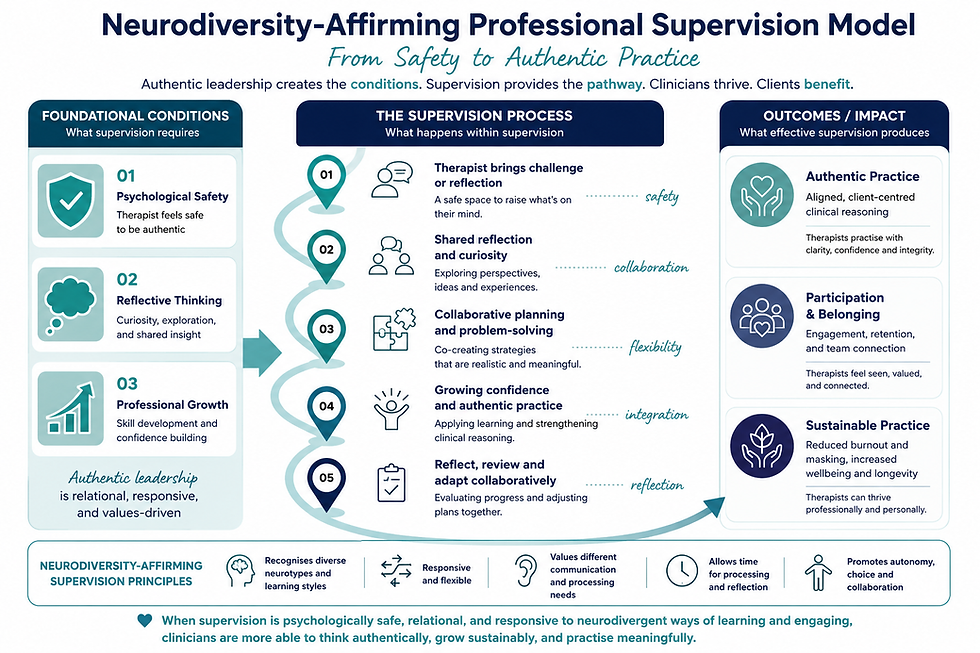
Image from Kate's OTX Poster 2026
The Neurodiversity-Affirming Professional Supervision Model begins with the foundational conditions required for therapists to feel safe enough to think, reflect and grow authentically. Psychological safety, reflective thinking and professional growth create the relational base of effective supervision: the therapist feels safe to be authentic, has space for curiosity and shared insight, and is supported to build confidence over time. These foundations are strengthened through neurodiversity-affirming supervision principles, including recognition of diverse neurotypes and learning styles, responsive and flexible practice, valuing different communication and processing needs, allowing time for processing and reflection, and promoting autonomy, choice and collaboration.
Within this foundation, the supervision process moves through five connected steps. It begins with the therapist bringing a challenge or reflection into the space, with supervision acting as a place to raise what is on their mind safely. This then develops into shared reflection and curiosity, where different perspectives, ideas and experiences can be explored without shame or judgement. From there, supervisor and supervisee engage in collaborative planning and problem-solving, co-creating strategies that are realistic and meaningful. As these strategies are applied, the therapist builds confidence and authentic practice by integrating learning into clinical reasoning and day-to-day work. The final step is reflective review, where progress, adjustments and learning are revisited collaboratively, creating an ongoing cycle of growth rather than a one-off supervision event.
When these conditions and processes are present, supervision produces meaningful outcomes for both therapists and clients. Therapists are more able to practise authentically, with clearer clinical reasoning, increased confidence and greater alignment with their values. They experience stronger participation and belonging through engagement, retention and team connection, rather than masking or simply “performing” professionalism. Over time, this supports sustainable practice by reducing burnout, strengthening wellbeing and helping therapists remain connected to their work in ways that are ethical, effective and personally sustainable.
When these elements are present, supervision becomes more than oversight. It becomes a space where clinicians can practise with greater confidence, integrity and authenticity.
What Neurodiversity-Affirming Supervision Looks Like
Neurodiversity-affirming supervision is not a checklist or a script. It is a stance.
It is grounded in curiosity, respect, flexibility, clarity, collaboration and shared responsibility.
It may include:
1. Psychological and Relational Safety
Clinicians need to feel safe enough to be honest.
This includes being able to say:
“I do not understand.”
“I need more time to think.”
“I am overwhelmed.”
“I made a mistake.”
“I am unsure how to proceed.”
“I need feedback in a clearer way.”
“I am finding this caseload emotionally difficult.”
“I am masking heavily and becoming exhausted.”
Relational safety does not mean avoiding difficult conversations. It means difficult conversations happen with respect, clarity, containment and care.
2. Clarity and Predictability
Many clinicians benefit from knowing what to expect from supervision.
This may include:
a clear agenda
written prompts before the session
predictable structure
explicit goals
transparent expectations
clear follow-up actions
written summaries after supervision
direct rather than implied feedback
opportunities to prepare rather than being put on the spot
For neurodivergent clinicians, clarity is not a luxury. It can be an access need.
A clear supervision structure reduces cognitive load and allows more capacity for reflection.
3. Flexible Communication
Not all clinicians process best through fast, verbal, face-to-face discussion.
Some may think better through:
writing
visual mapping
reflective prompts
case formulation templates
diagrams
email follow-up
voice notes
delayed processing time
movement during supervision
shared documents
structured clinical reasoning tools
Neurodiversity-affirming supervision allows communication to be functional rather than performative.
The goal is not for the supervisee to communicate in the supervisor’s preferred style. The goal is for supervision to support clear thinking, ethical reasoning and professional growth.
4. Sensory and Environmental Consideration
Supervision environments matter.
A clinician may be more reflective and regulated when the environment considers:
lighting
noise
room layout
seating
movement needs
visual clutter
privacy
interruptions
online versus in-person format
timing in relation to workload and energy
whether food, water, fidgets, or movement are acceptable
Small changes can significantly improve access to supervision.
A clinician who is using most of their energy to tolerate the environment has less capacity available for reflection.
5. Strengths-Based Reflection
Neurodiversity-affirming supervision does not only focus on what is difficult.
It also notices:
pattern recognition
deep empathy
creativity
persistence
strong ethical reasoning
specialist interests
honesty
systems thinking
attention to detail
capacity for deep focus
lived experience insight
strong advocacy skills
relational attunement
ability to notice what others miss
Strengths do not erase support needs. Support needs do not erase strengths.
Good supervision can hold both.
6. Contextualising Performance
When something is not working, neurodiversity-affirming supervision asks more than, “Why didn’t you do it?” - It asks:
Was the expectation clear?
Was the workload realistic?
Were there competing demands?
Was there enough processing time?
Was the environment accessible?
Was the clinician masking or overloaded?
Was the task broken down sufficiently?
Was the feedback understandable and actionable?
Was there a mismatch between the clinician’s strengths and the system’s demands?
This does not remove responsibility. It improves problem-solving.
When supervisors understand context, they can support safer and more sustainable practice.
The Role of Co-Regulation in Supervision
Supervision is not only cognitive. It is also relational and nervous-system based.
When a clinician brings a difficult case, ethical concern, mistake, conflict, complaint, or moment of uncertainty to supervision, they are often not just seeking information. They may also be seeking containment. A regulated supervisor can help create conditions where the supervisee can think again.
Co-regulation in supervision may involve:
slowing the pace
using a calm tone
naming the difficulty without shame
validating the emotional load
separating the person from the problem
helping organise the next step
supporting reflective distance
reducing urgency where appropriate
bringing the clinician back to values, ethics and clinical reasoning
This is not about making supervision soft or unstructured. It is about recognising that people reason better when they are not in threat mode.
For neurodivergent clinicians, who may have long histories of correction, misunderstanding or masking, co-regulation can be especially important.
Feedback Without Shame
Feedback is a central part of supervision. But feedback delivered without consideration of neurodivergent processing can be misheard, missed, overwhelming, or experienced as global criticism.
Helpful feedback is:
specific
timely
kind
direct
behaviour-focused
linked to expectations
supported by examples
paired with next steps
provided in a format the clinician can process
separated from assumptions about motivation or character
Less helpful feedback sounds like:
“You need to be more professional.”
“You should know this by now.”
“You’re not coping.”
“You need to be more organised.”
“You’re too emotional.”
“You’re overthinking it.”
“Just prioritise better.”
These statements may describe a concern, but they do not provide a pathway forward.
Neurodiversity-affirming feedback says:
“Here is the specific issue.”
“Here is why it matters.”
“Here is what needs to change.”
“Here is what support or structure may help.”
“Here is how we will review it.”
This protects dignity while still supporting accountability.

Supervision as a Protective Factor Against Burnout
Allied health clinicians are working in increasingly complex practice environments. Many are managing high caseloads, administrative load, emotional intensity, ethical tension, system pressure, and limited resources.
Neurodivergent clinicians may also be managing the additional load of masking, sensory exposure, executive functioning demands, social communication expectations, and fluctuating capacity.
Supervision can either add to this load or help buffer it.
Supportive supervision can help clinicians:
identify early signs of burnout
understand capacity changes
reduce unnecessary masking
prioritise work more effectively
process emotionally complex cases
maintain ethical clarity
identify reasonable workplace adjustments
build sustainable routines
reconnect with professional values
feel less alone in complex work
When supervision is safe, reflective and practical, it becomes a protective structure — not just a performance review.
Practical Adjustments That Can Support Neurodivergent Clinicians
Supervision can become more accessible through small but meaningful adjustments. These may include:
sending an agenda in advance
allowing written reflections before or after supervision
using visual clinical reasoning tools
offering direct feedback rather than hints or implications
providing clear priorities when multiple tasks are competing
reducing unnecessary sensory load
allowing movement, fidgets, or camera-off time when appropriate
documenting agreed actions
checking whether feedback has been understood as intended
allowing processing time before expecting a response
using templates for case discussion
separating urgent issues from reflective issues
supporting realistic workload planning
making expectations explicit
These adjustments do not lower professional standards -They improve access to those standards.

Image from Kate's OTX Poster 2026
For Supervisors: Helpful Questions to Ask
Supervisors can support more affirming practice by asking:
How do you process feedback best?
Would it help to have time to think before responding?
What parts of your workload are currently using the most capacity?
Are there any sensory or environmental factors affecting your work?
What helps you feel safe enough to reflect honestly?
Do you prefer verbal discussion, written notes, visual mapping, or a mix?
What signs tell you that you are becoming overloaded?
What supports have worked well for you before?
Are there parts of your practice where masking is becoming exhausting?
What would make the next step clearer?
These questions are not only for neurodivergent clinicians. They are useful questions for everyone.
For Supervisees: What You Are Allowed to Ask For
Clinicians receiving supervision are allowed to ask for support that helps them access the supervision process. This might include:
“Can I have the agenda beforehand?”
“Can I send my reflections in writing?”
“Can you be more direct about what needs to change?”
“Can we write down the action steps?”
“Can I have a moment to think before I answer?”
“Can we use a visual map for this case?”
“Can we separate the urgent issue from the reflective issue?”
“Can you clarify what standard you are expecting?”
“Can we review workload and capacity?”
“Can we talk about what is making this task hard?”
Asking for access is not a weakness. It is part of developing safe, sustainable professional practice.

What This Means for Practice Leaders
For practice leaders, neurodiversity-affirming supervision is not only an individual support strategy. It is part of building healthier professional cultures.
This means considering:
how feedback is given
how workload is structured
how mistakes are responded to
how sensory and communication needs are accommodated
how policies support flexibility
how clinicians are encouraged to seek help
how professional expectations are made explicit
how lived experience and neurodivergent insight are valued
how burnout is prevented, not just managed after crisis
how supervision is separated from surveillance wherever possible
A workplace that supports neurodivergent clinicians well is often a better workplace for everyone.
It tends to be clearer, kinder, more reflective, more ethical, more flexible, and more sustainable.
Key Takeaways
Neurodiversity-affirming supervision recognises that clinicians bring their whole nervous systems, identities, learning styles and processing differences into professional practice.
It is not about lowering standards. It is about improving access to reflection, feedback, accountability and growth.
Supervision should support psychological safety, clarity, flexible communication, sensory access, contextual understanding, strengths-based reflection and sustainable practice.
Masking can occur in professional spaces, and supervision should not unintentionally reward clinicians for hiding distress, confusion or overload.
When supervision is human-affirming, clinicians are more able to reflect honestly, practise ethically, seek support early, and remain connected to their professional values.
Supervision should not require clinicians to leave their humanity at the door. Neurodiversity-affirming supervision recognises that safe, reflective and sustainable practice grows from environments where clinicians can be understood, supported, challenged and valued. It holds accountability and compassion together and makes space for different brains, different communication styles, different ways of learning, and different paths to professional growth.
Ultimately, it reminds us that supporting clinicians well is part of supporting clients well.


The concept of neurodiversity-affirming supervision is essential in today's clinical environments. It challenges traditional methods that often overlook individual needs, especially for neurodivergent clinicians. By fostering an inclusive atmosphere, we can reduce unnecessary pressure, allowing clinicians to focus on authentic reflection and growth. In this way, the model resembles a “Lucky Elf” approach, where support is tailored to diverse processing styles and fosters genuine professional development.
The article provides a comprehensive analysis of the necessity for neurodiversity-affirming supervision in clinical settings. It raises essential questions about how supervision can either hinder or enhance a clinician's reflective practice. Engaging with diverse communication and processing styles can transform supervision, making it a space for growth rather than mere compliance. In a world increasingly reliant on technology, integrating elements like Pay ID https://gadsden.info/ can streamline feedback processes, fostering a cycle of support and understanding. This approach invites a deeper inquiry into how we can create environments that truly respect and accommodate all clinicians.
The article presents an essential dialogue on the significance of neurodiversity-affirming supervision. It raises critical issues related to the emotional and cognitive burdens faced by neurodivergent clinicians. The focus shifts from traditional compliance to fostering environments where authentic expression is possible. Fast Payout https://babysittersclub.co.nz/ is an intriguing concept that parallels the need for quick adaptability in supervision methods to accommodate various processing styles and enhance overall effectiveness.
The concept of neurodiversity-affirming supervision challenges conventional standards that often marginalize diverse communication and processing styles. By creating an environment that values authenticity and emotional safety, we can shift from mere compliance to genuine growth. This model acknowledges the complex realities clinicians face, emphasizing that the true measure of professionalism lies in ethical, reflective practices. Royal Reels captures this essence beautifully, illustrating how supervision must adapt to the individual needs of clinicians to foster a culture of inclusivity and resilience.